Consulting Insights
Business Insights | Singapore’s Shophouses Are Green — Just Not Certified
Closing the Green Gap: Why Singapore needs a Green Mark Standard built for conserved shophouses
August 4, 2026
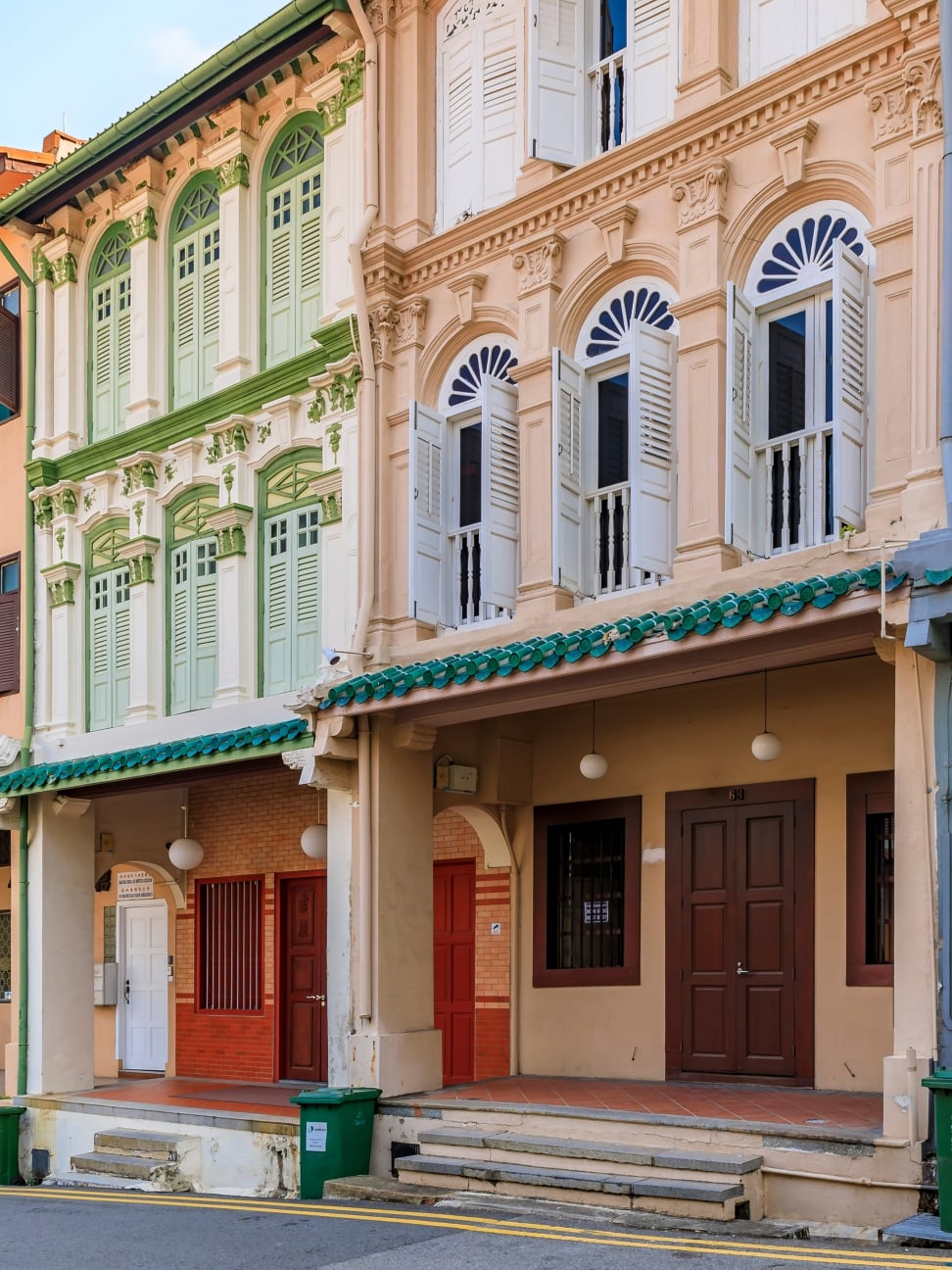
Walk along Tanjong Pagar Road on a weekday morning, or through Kampong Glam at dusk, and Singapore’s conserved shophouses do what they have always done: they work. Coffee shops spill onto five-foot ways; trendy bars and restaurants sit beside century-old clan associations; design studios and co-living accommodation share the same streets as traditional medicine halls and trades. These buildings are, by almost any measure, a model of what sustainable urban life can look like.
This is a testimony on how Singapore’s decade-long effort in building two reputations that the world admires: a city that takes green seriously, and a city that takes heritage seriously. However, rarely are these two ambitions examined together. This paper argues that they should be — and that the failure to do so is creating a quiet but consequential market problem.
This is the first of a two-part series. Part 1 sets out the structural challenge: how Singapore's Building and Construction Authority (BCA) Green Mark 2021 scheme, designed with conventional buildings in mind, finds itself poorly matched to the approximately 6,500 gazetted shophouses it was never quite built for. These buildings are not underperforming because their owners have underinvested. They are constrained by the same Urban Redevelopment Authority (URA) conservation guidelines that protect their character. These guidelines that restrict the envelope interventions Green Mark scores most heavily.
The result is a gap between what shophouses can genuinely achieve on sustainability, and what current frameworks are able to recognise. Part 2 will move from diagnosis to dialogue, engaging owners, architects, tenants, and regulators to develop practical, stakeholder-informed recommendations.
Together, the two papers make the case that sustainability is not only about the buildings we build, but about the ones we choose to keep.
A Framework Built for Conventional Buildings
Under the BCA Green Mark 2021 scheme, Singapore's flagship sustainability certification, conserved shophouses occupy a structurally challenging position, one that is not a reflection of owner ambition or investment, but an outcome of how current certification frameworks engage with heritage buildings. This dynamic is written into the regulatory architecture, and its commercial implications are growing harder to overlook.“Shophouse owners are penalised not for environmental neglect — but for legal obligations imposed by the state.”
Green Mark was designed, as most sustainability certification systems are, with conventional buildings in mind. Its highest-scoring interventions include solar photovoltaic panels on rooftops, high-performance glazing systems, external wall insulation and cool roofs, all of which assume that a building owner has full control over the building envelope. For most commercial property owners in Singapore, that assumption holds.For owners of the approximately 6,500 gazetted conserved shophouses across Chinatown, Little India, Kampong Glam, Emerald Hill, and Blair Plain, it does not. The URA’s conservation guidelines generally prohibit or severely restrict precisely these interventions. Clay tile roofs cannot be replaced with solar panels. External facades cannot be altered. Timber windows cannot be swapped for double-glazed aluminium systems. These are not optional constraints; they are the conditions under which any Additions & Alterations (A&A) permit is granted.
Interventions are often limited to internal systems. The result is that a shophouse owner who invests seriously in sustainability will typically reach Green Mark Certified or Gold — but rarely GoldPLUS or Platinum, the tiers increasingly demanded by institutional tenants, Real Estate Investment Trusts (REITs), and Environmental, Social and Governance (ESG) reporting corporations.
“The certification does not credit the passive performance embedded in the original heritage design.”
Without Green Mark, Market Looks Elsewhere
While shophouses have found their natural tenant base among the creative industry, boutique financial institutions, start-ups, and professional services firms, this traditional stronghold is now quietly eroding. ESG commitments, once perceived as the domain of large financial institutions and multinational corporations (MNCs), have permeated down to these smaller occupiers with equal seriousness. A start-up with a B-Corp certification, a boutique asset manager publishing its first sustainability report, or a law firm responding to client due diligence questionnaires on environmental practices: all are increasingly bound by the same green building expectations as their larger counterparts. Institutional investors are also committed to sustainability initiatives that can illustrate the extent of cost savings and attract tenants1. The result is a quiet but consequential market distortion. The very heritage qualities that make shophouses desirable as workplaces are legally protected in ways that prevent them from meeting the green certification benchmarks that tenants and investors now feel compelled to meet.“Conservation legislation and ESG procurement expectations are pulling in opposite directions, and it is the shophouse market that is caught between them.”
What Is Achievable Today
The constraints are real, but they are not total. A significant range of sustainability interventions remains open to conserved shophouse owners within URA’s guidelines, and their potential is not yet fully exploited by the market.High-efficiency air-conditioning systems, smart building management technology, LED lighting, water-efficient fixtures, low-volatile organic compound (VOC) materials, and rigorous indoor air quality standards are all available interventions. So is the intelligent activation of the shophouse’s vernacular design logic: the traditional courtyard and ridge ventilation system, high ceiling volumes, rear lightwells, and continuous shaded walkways are passive climate solutions that predate green building rating systems by a century. A well-managed adaptive reuse project, creative asset enhancement that deliberately activates these features can achieve genuine sustainability performance — and meaningful Green Mark scores. The recent case of the historical townhouse in Neil Road being the first conserved building to be energy self-sufficient in end-2027 after the repair and upgrading marks are completed is a good example of such attempt2.
Interim guidance jointly published by BCA and URA — setting out which interventions are conservation-compatible and what Green Mark credits they attract — would immediately empower owners and architects to begin acting, ahead of any formal framework change. It is a straightforward step with outsized practical impact.
“The vernacular architecture of the Singapore shophouse was climatically intelligent long before green building rating systems existed.”
More Than Energy: The Sustainability of Place
The deeper question is whether the current definition of sustainability is broad enough to capture what conserved shophouses actually contribute to urban life. Green Mark, as a framework, measures the environmental performance of buildings in isolation, including their energy consumption, water efficiency, indoor air quality. What it does not measure is the sustainability of places: the capacity of an urban district to remain economically diverse, socially coherent, and culturally legible over time. By that broader definition, shophouses are among Singapore's most sustainably performing assets.Their contribution operates at the street level. The five-foot way, the mixed-use ground floor, the fine-grained plot subdivision are not aesthetic features but structural conditions that generate street life, support small-scale enterprise, and sustain the kind of layered, walkable urbanism that makes districts like Chinatown, Kampong Glam and Little India economically and culturally distinctive. For the communities embedded in these areas — clan associations, religious institutions, independent traders — the shophouse is not incidental to their identity but constitutive of it. Urban research consistently shows that historic fine-grain fabric anchors social cohesion and supports diverse local economies in ways that large-format redevelopment cannot. Once that grain is lost, it cannot be rebuilt; the physical form and the community it sustains tend to disappear together.
There is a further argument that the industry has not yet made loudly enough. Every conservation shophouse is, in carbon terms, a bank. The emissions spent making its brick, cutting its timber and firing its tiles are already sunk. As long as the building stands, they stay that way. Demolition does not just erase history; it writes off that carbon entirely and incurs the far heavier cost of building anew. In an era of serious attention to embodied carbon, the case for conservation has an environmental dimension that has barely begun to be quantified, let alone communicated.
“The greenest building may be one already built.”
The Case for a Green Mark for Shophouses
The solution is well within reach, and there is international precedent. The UK’s BREEAM In-Use scheme, Australia’s Green Star Performance rating, and Hong Kong’s BEAM Plus have all begun developing differentiated assessment pathways for heritage buildings, allowing alternative compliance routes for credits relating to building envelope performance. Singapore, with arguably the most mature and well-resourced heritage conservation and green building systems in Southeast Asia, is ideally positioned to go further than any of these precedents.What is needed is a dedicated Green Mark for Shophouses: a certification track designed from first principles to reflect the realities of conserved shophouse ownership. This would include automatic credit exemptions for conservation-prohibited upgrades, elevated weightings for passive design and indoor environment quality, recognition of embodied carbon and heritage stewardship as environmental goods, and — most innovatively — a formal Placemaking & Community Vitality scoring category that credits the social, cultural, and public realm contributions of well-managed heritage properties.
An example of this includes the Temasek Shophouse, where a new outdoor community space was created to support biodiversity while creating accessible spaces for environmental learning and public participation. This marks the completion of a multi-year transformation that integrates heritage-led sustainability and community engagement.
Governance of such a pathway would require multi-agencies collaborations, with BCA, URA, the Fire Safety and Shelter Department, and the National Heritage Board (NHB) working in concert, and the Singapore Tourism Board serving an advisory role. This is not a novel governance structure: BCA already operates differentiated tracks for data centres. A Heritage Pathway is the natural next step in that evolution.
Recognising the Full Value of Conservation
Behind every well-kept shophouse is an owner who has chosen the harder path. They carry costs that do not appear on a standard yield analysis: heritage tenants retained at below-market rents because their presence sustains the character and community that make these streets worth preserving; building fabric maintained to conservation standards that go far beyond what commercial logic alone would require; restoration work undertaken not for returns, but for continuity. These are acts of stewardship, and they have largely gone unrecognised by the frameworks Singapore uses to measure both sustainability and value. A dedicated Green Mark for Shophouses would begin to change that. Not by softening the certification, but by finally building one that sees what these buildings, and the people who care for them, actually do. The conservation of a shophouse is not only the preservation of a physical structure. It is the preservation of the street life around it, the enterprises within it, and the communities whose identity is inseparable from it. Singapore's green building ambitions and its heritage ambitions have always been asking the same question: what kind of city do we want to keep? It is time the answer counted both.Singapore Consulting's Fit-for-Purpose Perspective
At Singapore Consulting, our four practices cover the full range of what clients need to assess, strategy, finance and execute sustainability initiatives, from portfolio-level climate risk to individual asset retrofit plans.Paia FROM CBRE runs climate risk assessments and stress tests at the asset and portfolio level, identifying physical and transition risks and translating them into concrete investment and asset management decisions.
Real Estate Insights & Advisory provides the market intelligence to identify where the brown discount is accumulating, where the green premium is available, and where the highest-value repositioning opportunities lie, including within Singapore's supply-constrained conservation shophouse market.
Workplace Strategy helps landlords and occupiers align building performance with leasing decisions, connecting sustainability credentials to tenant demand in a market where net zero commitments are increasingly a precondition for signing.
Strategic Asset Solutions delivers costed, executable retrofit plans that account for URA conservation constraints, original building fabric, and the embodied carbon calculus that standard retrofit models typically overlook. These plans help improve energy performance, reduce carbon tax liability, and protect asset value.
Sources and Citations
1 CBRE. (2026, February). 2026 Asia Pacific Investor Intentions Survey.
https://www.cbre.com.sg/insights/reports/2026-asia-pacific-investor-intentions-survey.
2 The Straits Times. (2026, April). Historical townhouse set to be S’pore’s first energy self-sufficient heritage building.
https://www.straitstimes.com/singapore/decades-old-townhouse-set-to-be-spores-first-energy-self-sufficient-heritage-building.