Consulting Insights
Business Insights | The Ventilation Paradox: Why Singapore's Buildings Are Optimised for the Climate That Was
November 17, 2026
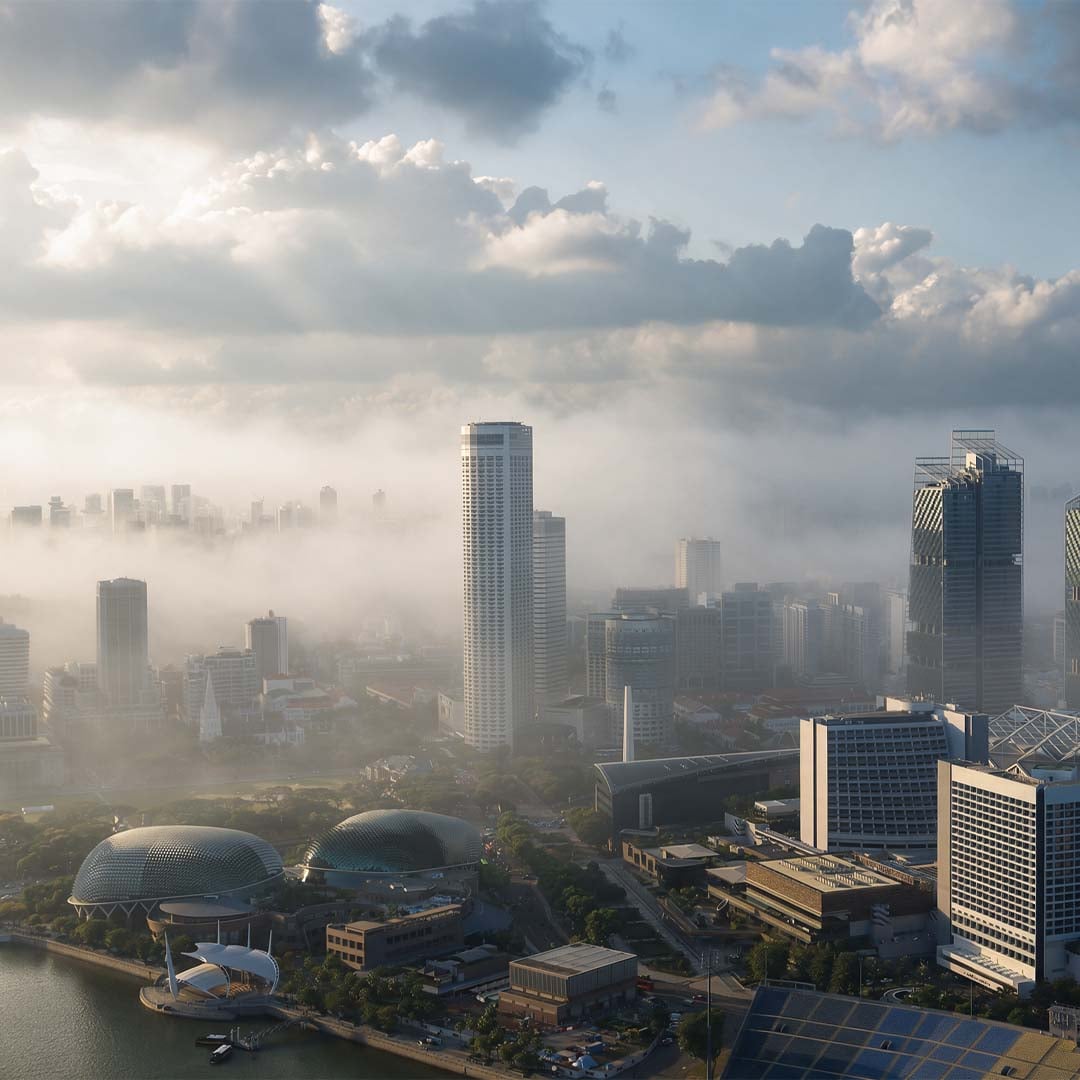
Singapore’s haze in September and October 2026 produced the worst single-day air quality readings in more than a decade. Preliminary
estimates also project S$3.2 to S$3.9 billion in economic losses. Beyond the economic toll, the haze tests every building and workplace in
the city-state. Updates to standards on indoor air quality have done much to strengthen the resilience of commercial buildings and safeguard their occupants. However, in our view, the standards help to set a floor, and building owners who treat that floor as a ceiling leave their occupants, assets and carbon liabilities vulnerable. The risk is growing. The Mandatory Energy Improvement target of a 10% cut in energy intensity can push owners to reduce ventilation, with no indoor air quality safeguard required. We call this the ‘Ventilation Paradox’. In this article, we explain how this paradox presents itself in practice and the implications for occupiers and building owners, as well as offer practical solutions and the way forward.
| At a Glance | |
| The gap | Standards set a floor. SS 554:2026 introduces a haze mode but does not require the sensors or controls to trigger it. |
| The risk | Energy targets can push owners to cut ventilation with no air quality safeguard. |
| The fix | Upgrade filtration and indoor monitoring now, then build haze-responsive ventilation. |
| The ask | Before the next haze season, audit whether your building can respond to outdoor air quality data, then upgrade filtration and plan haze-responsive ventilation. |
What happened, and what the standards say
Singapore’s haze episodes persisted for the entire month of September and into October:
- 4 September: Singapore recorded a 24-hour Pollutant Standards Index (PSI) of 123, the first unhealthy reading since October 2023.
- 9 October: The 24-hour PSI peaked at 192, Singapore’s worst single day reading in more than a decade.
- 14 October: 1-hour Particulate Matter (PM) 2.5 in the western region reached 288 micrograms per cubic metre, entering the Very High band, the highest reading since 20151.
In July 2026, the Singapore Institute of International Affairs (SIIA) issued a red risk rating in its Haze Outlook 2026 report2, only the second since 2019, flagging August and September as the peak danger period. Haze is a recurring seasonal condition, linked to land-clearing fires in Sumatra and Kalimantan.
The standards have moved with every episode. Amendment No. 1 to Singapore Standard (SS) 554:2016, published in 2021, introduced for the first time a requirement to use Minimum Efficiency Reporting Value (MERV) 14-grade or equivalent high-efficiency filters during haze events. SS 554:2026 goes further, formally introducing a resilience mode that covers both haze and infection risk management, and references continuous monitoring. Each revision was a response to demonstrated negative impacts. The recent episode shows why buildings that have the infrastructure to detect and respond to those conditions in real time are critical.
The Ventilation Paradox explained
SS 554:2026 is the most significant advance in Singapore’s indoor air quality framework in a decade. Its new resilience mode acknowledges that episodic outdoor air quality events require a specific operational response to haze, not just routine ventilation management. These are genuine advances. They do not, however, mandate the sensors to detect haze conditions in real time, or the automated controls to act on that detection.
The standard also includes continuous monitoring as part of that resilience framework. Buildings drawing in outdoor air at standard ventilation rates were importing concentrations more than five times Singapore’s annual guideline, without the sensor infrastructure or automated controls to detect and respond to what was happening outside.
The data to act on already exists. The National Environment Agency (NEA) publishes real-time PSI and 1-hour PM2.5 readings because the information is actionable for individuals deciding on outdoor activity. No Singapore standard requires that same data to trigger a response in a building's HVAC or air cleaning system. Combining information from the public domain monitoring infrastructure with voluntary operational improvements will deliver the intended benefits of Singapore's strongest standard yet. The path from compliance to genuine resilience runs through Green Mark Version 7 (v7) certification and the practices it rewards.
Standards set a floor. Treat it as a ceiling and you leave occupants, assets and carbon liabilities exposed.
Three assumptions that no longer hold
The first assumption is that outdoor air is fresh. SS553:2026 sets minimum requirements for thermal comfort, with only general consideration for indoor air quality. It does not require outdoor air intake to respond to real-time pollutant data.
The second assumption is that air-handling unit (AHU) filtration alone controls air quality risk. The joint NEA, Building and Construction Authority (BCA) and Ministry of Health (MOH) Updated Guidance Note on Improving Ventilation and Indoor Air Quality in Buildings states that filters with a rating of at least Minimum Efficiency Reporting Value (MERV) 14, F8 or efficiency of PM1 particles (ePM1) 70 to 80% are necessary to substantially remove fine particles, including most viruses and bacteria4.
5These ratings are currently optional enhancements under Green Mark v7, not mandatory minimums. Buildings earning neither are operating below the level that Singapore's own official guidance identifies as necessary to substantially capture fine particles, such as during the haze episode when fine particle concentrations are at their highest.
The third assumption is that hybrid cooling is Indoor Air Quality (IAQ)-neutral. 6Without outdoor air quality responsiveness built into the system, a building operating in hybrid mode during a haze event has no automated mechanism to protect occupants from elevated outdoor PM2.5. The energy rules add pressure. The Mandatory Energy Improvement (MEI) regime requires owners of energy-intensive commercial buildings of 5,000 square metres gross floor area or more to reduce energy use intensity by at least 10% . For most commercial buildings, HVAC is the dominant energy load. Buildings developing their Energy Efficiency Improvement Plans may reduce ventilation rates to meet this target. No compensating IAQ safeguard is required.
During a haze event, an adaptive ventilation system that reduces outdoor air intake in response to poor outdoor air quality would simultaneously improve indoor PM2.5, reduce energy consumption and lower carbon tax liability at the same time. Current standards do not require this capability.
Green Mark Version 7: The certification floor just rose
BCA launched v7 on 2 September 2026 in what is the most significant revision to Singapore's green building certification framework in several years, and its Health and Wellbeing section directly addresses the ventilation paradox through three Clean Air credits:
- Ultraviolet Germicidal Irradiation (UVGI): UV-C air disinfection at air-handling units in-duct, or in upper rooms, covering at least 90% of regularly occupied spaces.
- Air Filtration: Permanent ePM1 70% filters (ISO 16890), or MERV-A 14 filters (ASHRAE 52.2 Appendix J), in airside systems.
- Infectious Aerosol Control: A Building Readiness Plan demonstrating minimum clean airflow rates for infection risk management mode.
Each credit is optional. None is a mandatory prerequisite for Green Mark certification. This is precisely the gap the ventilation paradox identifies. For owners, the credits also work as a ready-made upgrade checklist.
Every Green Mark v7 clean air credit is optional. That is the gap.
The Carbon Dimension: A liability now on the balance sheet
Singapore’s carbon tax rose to S$45 per tonne of carbon dioxide equivalent (CO2e) from 1 January 2026, on a legislated path to S$50 to S$80 per tonne by 2030 under the Carbon Pricing Act8.
For commercial building owners, HVAC is the primary contributor to indirect emissions from energy consumption (Scope 2), and the ventilation paradox sits at its centre. The reason is specific to Singapore’s climate. Research funded by the Singapore National Research Foundation, found that dehumidification of outdoor air accounts for more than 80% of the total energy needed for building ventilation in Singapore’s tropical climate9. Every litre of haze-laden outdoor air drawn in at standard rates during September and October 2026 likely carried both a health cost and a carbon cost, and the carbon cost was disproportionately high precisely because of Singapore’s humidity.
This makes adaptive ventilation the more carbon-effective of the two paths to resolving the paradox. Reducing outdoor air intake during a haze event removes the dominant energy load directly, simultaneously improving indoor PM2.5, lowering cooling energy demand and cutting carbon tax liability. A building that connects NEA's live haze data to its ventilation controls does not have to choose between health and carbon performance. It gets both. Filter upgrades add a small energy cost, well below the impact of ventilation changes. Owners who sequence active indoor air quality measures now and adaptive ventilation next will meet their EEIP targets, lower their reported Scope 2 emissions and build the capability to respond before the next haze event. September and October 2026 showed the cost of inaction.
Building owners who sequence active indoor air quality measures now and adaptive ventilation capability next will lower their reported Scope 2 emissions and build the infrastructure to respond to the next haze event before it arrives.
The case for acting now
The case for acting spans across three dimensions:
- Health: BCA’s joint research with the National University of Singapore confirmed that Green Mark-certified buildings maintain lower pollutant concentrations and significantly fewer reported health symptoms among occupants, a finding produced under normal air quality conditions10. During a haze episode, when the primary pollutant source is the outdoor air supply itself, the gap between buildings with and without active air quality management is larger.
- Economic: 11The preliminary S$3.2 to S$3.9 billion estimate for Singapore's September and October 2026 haze episodes is more than double the S$1.83 billion recorded in 2015.
- Carbon: Carbon tax is S$45 per tonne and legislated to reach S$50-80 by 2030. Every unnecessary litre of haze-laden air drawn in adds to that liability.
The three dimensions point to the same conclusion. Buildings that managed outdoor air intelligently during the 2026 episode protected their occupants, reduced their energy consumption and lowered their carbon liability.
The buildings that managed outdoor air intelligently during the 2026 haze episode protected their occupants, reduced their energy consumption and lowered their carbon liability.
CBRE Singapore’s Fit-for-Purpose Perspective
Building owners face two paths to address the ventilation paradox, and the right answer depends on where a building starts.
Path 1: The first is adaptive ventilation for the building to respond to outside air. This means connecting NEA's real-time haze data to the building management system, upgrading outdoor air intake controls to modulate supply when PM2.5 exceeds a threshold, and pairing that reduction with higher-efficiency filtration to compensate for less dilution. SS 554:2026's haze mode points in this direction. For most existing buildings, this requires re-engineering Building Management System (BMS) control logic that was never designed for air quality response.
Path 2: The second is active IAQ measures to clean inside air regardless of what comes in. Upgrading filters to MERV 14 or ePM1 70%, deploying continuous indoor PM2.5 monitoring, and adding germicidal ultraviolet light to air handling units does not require touching the BMS or re-engineering control logic. It is achievable within a normal maintenance cycle, aligns with NEA-BCA-MOH guidance, and earns Green Mark v7 clean air credits. But high-efficiency filtration reduces indoor PM2.5 without stopping contaminated outdoor air from coming in. It mitigates the risk. It does not eliminate it.
The ventilation paradox is ultimately a question about how we expect a building to perform at CBRE Singapore Consulting, our answer is framed around three qualities.
- Sustainable: Buildings and workplaces that treat outdoor air as a variable to manage, not a fixed input to maximise. They cut the cooling load behind more than 80% of ventilation energy and meet MEI targets without compromising air quality.
- Smart: Buildings and workplaces that respond to what is happening outside. They connect to NEA's real-time haze data, monitor indoor PM2.5 continuously, and switch to haze mode without waiting for a facilities manager to act.
- Secure: Buildings and workplaces that protect occupants from the invisible threats as well as the digital and physical ones: fine particles, pathogens and chemical pollutants in the air supply, which September 2026 made impossible to ignore.
What to do before the next haze season
SIIA has flagged August and September as the peak danger period. Prepare in advance following three step.
- Audit whether your BMS can respond to outdoor air quality data.
- Move to MERV 14 or ePM1 70% filtration and add continuous indoor PM2.5 monitoring. It fits a normal maintenance cycle and earns Green Mark v7 credits.
- Build haze-responsive ventilation into your EEIP.
Resilience is insurance against economic losses, carbon liability and reduced worker health and safety.
Speak to our team about a haze-readiness assessment for your building or workplace.
How can we help
- Strategic Asset Solutions assesses which path is viable for each asset: auditing BMS capability for haze-responsive outdoor air modulation or sequencing filter and sensor upgrades within MEI Energy Efficiency Improvement Plans.
- Workplace Strategies connects the IAQ investment to the occupier value proposition, translating continuous PM2.5 monitoring data into a health dashboard that demonstrates to tenants, in real time, the improved performance of their building space.
- Real Estate Insights and Advisory maps the value consequence and where the rent premium for in-demand verified healthy-building performance is going.
- Paia FROM CBRE offers gap assessments, practical solutions and certification services.
2 https://siiaonline.org/siia-haze-outlook-2026-media-release/
3 Ministry of Sustainability and the Environment (2024). Singapore Ambient Air Quality Targets, www.mse.gov.sg/policies/clean-air/
4 Building and Construction Authority / National Environment Agency / Ministry of Health (2021, updated 2023), www.bca.gov.sg/docs/default-source/docs-corp-news-and-publications/circulars/faqs-for-guidance-note.pdf
5 Building and Construction Authority (2026). Green Mark Version 7 Health and Wellbeing Technical Guide, Revision 1, www.go.gov.sg/gmv7-hw-techguide
6 Enterprise Singapore / Singapore Standards Council (2025). TR 141:2025 Hybrid cooling system for air-conditioning, www.enterprisesg.gov.sg/grow-your-business/boost-capabilities/quality-and-standards/standards-technical-references-and-workshop-agreements
7 Building and Construction Authority (2024). Code on Mandatory Energy Improvement for Existing Buildings, Edition 1.0, issued June 2025, www.bca.gov.sg/sustainability/legislation-on-environmental-sustainability-for-buildings/existing-buildings/mandatory-energy-improvement-mei-regime/
8 National Climate Change Secretariat (2026), www.nccs.gov.sg/singapores-climate-action/mitigation-efforts/carbontax
9 Rim D, Schiavon S, Nazaroff WW (2015). Energy and Cost Associated with Ventilating Office Buildings in a Tropical Climate. PLOS ONE 10(3): e0122310. Singapore National Research Foundation funded.
10 Building and Construction Authority (2025), www.bca.gov.sg/resources/newsroom/twenty-years-of-greening-buildings-in-singapore-results-in-annual-energy-savings-that-can-power-one-million-4-room-hdb-flats-per-year/
11 See Footnote 5 (Eco-Business / Prof Euston Quah, 16 October 2026).